

Custom Decorative Aluminum Profiles may sound like an undertaking with a fairly high barrier to entry. Designers are concerned about whether a cross-section can be realized, procurement professionals worry about lead times and costs, and construction teams focus on the final fit during installation. Different roles have different priorities, but a complete cognitive map of how the entire process operates is often missing.
In reality, a mature process for Custom Decorative Aluminum Profiles, from drawing to finished product, is a chain of interlocking steps, each with clear milestones and delivery standards. Foshan Xingtaomei Aluminum Industry Co.,Ltd, as a manufacturer with complete capabilities in the field of decorative aluminum profiles, handles a large volume of custom orders every year. The following is a complete breakdown of this process.
Drawing Evaluation: Translating Design Language Into Manufacturing Language
The starting point of customization is a drawing.
This drawing can be a standard CAD file, marked with the cross-sectional shape, dimensions, tolerances, and surface requirements. It can also be a hand-drawn sketch accompanied by reference images, merely outlining the general form and key measurements. The format can be flexible, but the information the drawing carries must be complete - where the profile will be used, what function it will serve, and what surface effect is desired. These factors determine the direction of all subsequent steps.
Once the drawing reaches the manufacturer, the first task is a feasibility assessment. This stage does not involve production, yet it deserves more attention than production itself. The assessment covers: whether the cross-sectional structure is suitable for extrusion, whether the wall thickness design is reasonable, whether the surface treatment process matches the usage environment, and whether there are any hidden processing difficulties that need to be resolved upfront.
At this stage, Xingtaomei Aluminum systematically reviews the key information in the drawing. An experienced team can often determine the general feasibility and potential risk points of a cross-section within minutes. If issues are identified, adjustment suggestions are communicated to the client at the earliest opportunity. This proactive professional judgment is the first manifestation of a Custom Decorative Aluminum Profile Manufacturer's core value.
Plan Confirmation and Quotation: Finalizing Details Before Production Begins
After the feasibility assessment is passed, the process moves into plan confirmation and quotation.
The core of plan confirmation is translating all vague descriptions into executable parameters. Cross-sectional dimensions are specified to the millimeter, surface colors are matched to specific color swatches or codes, the surface treatment process is clearly defined as anodizing, powder coating, or wood-grain transfer, and delivery lengths and deep processing requirements are listed item by item. The more meticulously this stage is handled, the smaller the deviations will be in subsequent steps.
The quotation typically consists of three parts: mold cost, sampling cost, and bulk unit price. The mold cost depends on the complexity of the cross-section, the sampling cost covers the trial extrusion and sample production expenses, and the bulk unit price is tied to the total order quantity. A transparent quotation breaks down every cost, with no vague lump-sum pricing.
Mold Making and Sampling: Verifying the Design Feasibility With a Physical Sample
After the plan and quotation are confirmed, the mold-making phase begins.
The mold is the core tool for extrusion, with the cross-sectional shape directly engraved into it. Once the mold is fabricated, a trial extrusion is performed on the extrusion press to produce the first sample. The sample undergoes in-house inspection - whether dimensions are within tolerance, whether there are any surface scratches or defects, whether the overall effect matches the drawing - and is sent to the client only after passing this check.
Sampling is the most important verification milestone in the Custom Decorative Aluminum Profiles process. After receiving the sample, it is recommended to inspect it at three levels: first, dimensional accuracy - use a caliper to check whether the key dimensions meet the standards; second, surface effect - observe the color and texture under different lighting conditions to see if they match expectations; third, installation compatibility - place the sample in the actual installation environment to check how it coordinates with surrounding materials.
If adjustments are needed - whether modifying cross-sectional dimensions, changing the surface color, or adjusting process parameters - this is the stage to complete them. Once the sample is approved, this plan is locked in as the standard for mass production.
Xingtaomei Aluminum is equipped with multiple extrusion presses of different tonnages, with small-tonnage equipment specifically dedicated to sampling and small-batch trial production. This production line configuration gives the sampling stage its own independent production channel, without needing to wait in line for availability on the larger lines.
Extrusion: From Aluminum Billet to Profile Blank
Once the sample is confirmed, mass production officially begins.
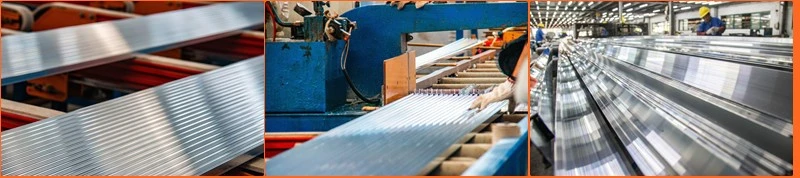
Extrusion is the first step in forming the profile. After being heated, the aluminum billet is forced through the die opening under the high pressure of the extrusion press, instantly taking on the predetermined cross-sectional shape. The extruded profile then undergoes online cooling and stretch straightening to ensure the straightness and dimensional stability of each piece.
The extrusion stage has a profound impact on the quality of Decorative Aluminum Profiles. The precision of the cross-section, the smoothness of the surface, and whether there are internal material defects are all largely determined at this step. Xingtaomei Aluminum possesses complete upstream processes from casting to extrusion, with standardized control over everything from the aluminum billet composition to the extrusion process parameters, laying a stable foundation for the subsequent steps.
Surface Treatment: Giving the Profile Its Final Visual Texture
The extruded profile is still in its raw aluminum color. Surface treatment gives it its final color and texture. For decorative aluminum profiles, this step directly determines the product's "visual appeal."
Common surface treatment methods include anodizing, powder coating, and wood-grain transfer. Anodizing forms a dense oxide film on the aluminum surface, with a fine texture and a natural metallic luster. Powder coating offers a rich selection of colors with strong hiding power, suitable for matching specific color schemes. Wood-grain transfer can reproduce wood textures on the aluminum profile surface, closely resembling the look and feel of solid wood both from afar and up close.
An easily overlooked but crucial indicator in the surface treatment stage is batch-to-batch color consistency. A single project is often supplied in multiple batches. If the color deviates between earlier and later batches, it will be very noticeable once installed together. Xingtaomei Aluminum possesses a complete anodizing production line, with all surface treatment completed in-house. Process parameters and quality inspection standards are under unified control, ensuring color stability between batches right from the source.
Deep Processing and Delivery: Making Profiles Ready for Use On-Site
After surface treatment is complete, the process moves into the deep processing stage according to client requirements.
Fixed-length sawing is the most common processing need - pre-cutting the 6-meter-long profiles according to installation dimensions, eliminating the need for on-site cutting. Beyond this, drilling, tapping, and end-milling can also be completed synchronously. Xingtaomei Aluminum is equipped with professional punching, drilling, and precision cutting equipment, capable of completing various types of processing according to drawing specifications. Once delivered to the site, the profiles can go directly into installation.
Before leaving the factory, every batch of products undergoes final inspection. The company has passed ISO9001 quality management system certification and CQM certification. From extrusion to surface treatment to deep processing, every step has corresponding inspection standards and records.
Behind the Process, a System Is in Operation
Having broken down the entire process, it becomes clear that Custom Decorative Aluminum Profiles is not a profoundly complex undertaking. It consists of six well-defined stages - drawing evaluation, plan confirmation, mold making and sampling, extrusion, surface treatment, and deep processing and delivery - each with clear inputs and outputs.
What truly makes this process run efficiently is the manufacturing system and quality control capability behind the manufacturer. With self-owned production lines, delivery times and quality are held in one's own hands. With a dedicated sampling line, small batches are not left in limbo. With complete surface treatment capabilities, color and texture can be unified. With a standardized quality control system, every link is traceable.
Foshan Xingtaomei Aluminum Industry Co.,Ltd possesses a complete production line from extrusion and surface treatment to deep processing in the field of decorative aluminum profile manufacturing. Whether it is a one-time sampling verification or a long-term bulk custom supply, we can provide the matching production capacity and technical support.
If you are planning a Custom Decorative Aluminum Profiles project, whether you have drawings in hand or just an initial idea, you are welcome to communicate with us. We have professional customer service online, ready to quickly connect you with our technical team for evaluation, accompanying you from the drawing all the way through to finished product delivery.